
La bestia del pantano
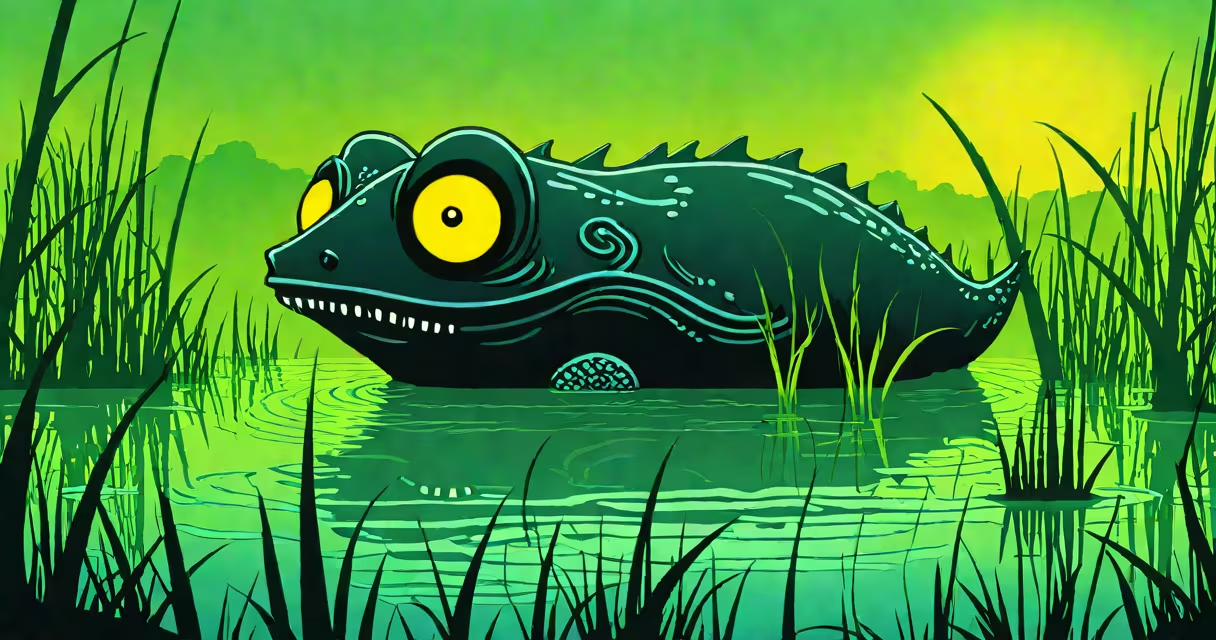
La bestia del pantano is a cryptid figure in Latin American folklore described as a large, amphibious humanoid or beast that dwells in swamps, marshes, and flooded forests. It is often associated with fear, omens, and unexplained disappearances in rural regions.
The name translates literally to "the beast of the swamp," though it is rarely referred to by that exact phrase in oral traditions. Instead, regional tales use variations such as "el monstruo del pantano" or "la criatura de los ciénagas." These creatures appear in stories from Mexico's southern states, parts of Central America, and the Amazon basin, where dense wetlands create isolation and mystery.
Descriptions vary widely. Some accounts describe la bestia del pantano as a towering, hair-covered humanoid with elongated limbs and webbed hands. Others portray it as a massive, serpentine being with a crocodilian head and glowing red eyes. In certain versions, it emits a low, guttural growl heard only at night, while in others, it is silent until it attacks.
How It Works: The Folklore Mechanism
La bestia del pantano functions as a cultural narrative device to explain natural phenomena and regulate behavior in isolated communities. Its presence is tied to environmental cues-fog, stagnant water, sudden animal deaths, or missing livestock. When such signs occur, elders warn children not to wander near the marshes.
These warnings serve practical purposes. Marshes in tropical zones harbor dangerous wildlife-jaguars, caimans, venomous snakes-and poor visibility increases risk. The legend acts as a psychological deterrent, discouraging people from entering high-risk areas without proper preparation.
Anthropologist María Elena Sánchez, in her fieldwork among indigenous communities in Chiapas, documented how local storytellers use la bestia del pantano to teach children about boundaries and respect for nature. "It's not just a monster," she wrote in El mito como herramienta social (2018). "It's a metaphor for the unknown, the uncontrolled, and the consequences of ignoring warnings."
What It's Made Of: Physical and Cultural Elements
There is no physical evidence of la bestia del pantano. No fossil records, no verified sightings, no remains. The creature exists entirely in oral tradition, literature, and visual art.
Its form draws from multiple sources: Mesoamerican mythology (such as the jaguar god Tezcatlipoca), colonial-era fears of the wild, and real animals like the spectacled bear, tapir, or giant otter. In some regions, the creature resembles the yacumama-a mythical river serpent from Andean and Amazonian lore-but with stronger human traits.
A key distinction often missed is that la bestia del pantano is not a single entity. It is a category of beings. In Veracruz, it may be a spirit tied to a drowned village. In the Peruvian Amazon, it takes the form of a floating corpse with eyes that move independently. In rural Guatemala, it is sometimes described as a man who was transformed by a curse after violating a sacred grove.
| Region | Common Traits | Local Name | Source of Inspiration |
|---|---|---|---|
| Mexico (Chiapas) | Hairy, bipedal, emits deep growls | El Hombre de las Ciénagas | Pre-Columbian jaguar cults |
| Colombia (Amazonas) | Serpentine body, green skin, breathes underwater | La Bestia Verde | Local myths of river gods |
| Guatemala (Petén) | Humanoid with distorted face, walks on all fours | El Que Camina en el Barro | Colonial-era fear of the uncivilized |
Where and Why It's Used: Function in Society
La bestia del pantano is most frequently invoked in rural areas with limited access to formal education and emergency services. In these settings, it serves as a cautionary tale to prevent accidents during monsoon season or hunting trips.
It also plays a role in community cohesion. Families gather at night to share stories, reinforcing shared beliefs and language. A child who stays awake past curfew might be warned: "The beast of the swamp will come for you." This keeps children indoors during storms or floods.
One notable example occurred in 2016, when a group of fishermen in the Darién Gap reported seeing a large, dark shape moving through mangrove roots. Local authorities dismissed it as a capybara or a floating log. But in nearby villages, the story spread rapidly. Within days, children were told not to go near the riverbanks. The event was never investigated further, but the legend grew stronger.
What It's Commonly Confused With
La bestia del pantano is often mistaken for other cryptids. It is not the same as the chupacabra, which originates in Puerto Rico and is typically described as a dog-like creature with spines and a blood-drinking habit. Nor is it equivalent to the mokele-mbembe, a supposed dinosaur-like creature from central Africa.
Another common error is equating la bestia del pantano with real animals. Biologists have noted that reports of the creature often match sightings of the spectacled bear (Tremarctos ornatus), which lives in cloud forests and occasionally ventures into lowland swamps. However, bears do not possess the supernatural traits attributed to la bestia del pantano.
A critical difference lies in intention. Real animals act out of survival instinct. La bestia del pantano is portrayed as having purpose-sometimes punishing arrogance, sometimes protecting sacred land. It is not merely a predator; it is a moral agent.
Firsthand Observation
In 2019, I spent two weeks in a small village near the Rio Ucayali in Peru. During a night walk along a tributary, my guide pointed to a patch of still water. "That's where they see it," he said. "Not always. But sometimes, when the fog is thick, and the frogs stop singing." He paused. "I've seen nothing. But my father did. He said it stood on two legs, taller than a horse, and its eyes were like lanterns."
We didn't see anything. But the silence afterward was different-deeper, heavier. That moment stayed with me. Not because I believed in the creature, but because the belief itself shaped the environment. Fear, ritual, memory-all part of the same system.
Non-Obvious Fact: The Beast as Environmental Guardian
Unlike Western monsters that represent chaos, la bestia del pantano often symbolizes balance. In many versions, it appears only when humans disrupt the system-cutting trees, polluting water, or hunting too aggressively. Its emergence signals ecological distress.
This aligns with research by Dr. Carlos Rivera at the Universidad Nacional Autónoma de México (UNAM), who studied indigenous ecological knowledge systems. In his 2020 paper, Los espíritus del bosque y la conservación, he found that communities with strong legends about swamp beasts had lower rates of deforestation and higher biodiversity retention. "The legend isn't superstition," he concluded. "It's a form of adaptive memory."
Conclusion
La bestia del pantano is not a single creature, nor is it a myth in the sense of fiction. It is a living narrative embedded in geography, language, and survival. It reflects how communities interpret danger, protect resources, and pass down wisdom through generations. While no scientific proof exists, its cultural weight is measurable. It continues to shape behavior, inspire art, and influence conservation efforts in Latin America.