
organs of musculoskeletal system
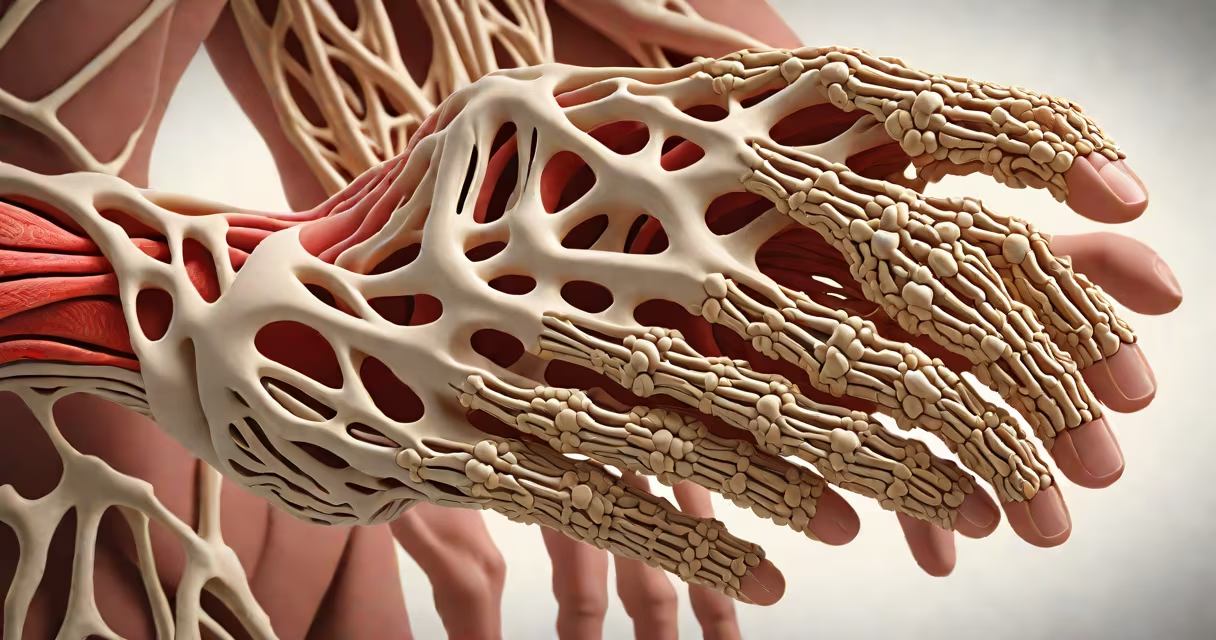
The organs of the musculoskeletal system are the bones, muscles, tendons, ligaments, and joints that provide structural support, enable movement, and protect internal organs. Together, they form the structure responsible for posture, locomotion, and physical stability.
Bones make up the skeletal component. They are rigid structures formed primarily from calcium phosphate and collagen. The adult human skeleton contains 206 bones, including the cranium, vertebrae, ribs, sternum, pelvis, and limb bones. These bones serve as attachment points for muscles and shield delicate organs such as the brain and heart.
Muscles constitute the muscular component. There are three types: skeletal, cardiac, and smooth. Skeletal muscles, which are voluntary and attached to bones via tendons, generate force through contraction. The biceps brachii in the upper arm and the quadriceps femoris in the thigh are examples of large skeletal muscles involved in limb movement.
Tendons connect muscle to bone. Made of dense regular connective tissue, they transmit the mechanical force generated by muscle contractions to the skeleton. A rupture in the Achilles tendon, for example, can severely impair walking and running ability.
Ligaments stabilize joints by connecting bone to bone. They are composed of fibrous bands rich in collagen. The anterior cruciate ligament (ACL) in the knee prevents excessive forward movement of the tibia relative to the femur. ACL injuries are common in sports involving sudden stops or directional changes.
Joints are the sites where two or more bones meet. They allow controlled motion and vary in complexity. The shoulder joint is a ball-and-socket joint enabling many motion. The elbow is a hinge joint permitting flexion and extension. The spine contains synovial joints between vertebrae, allowing limited bending and rotation.
These organs function as an integrated unit. When a person lifts a suitcase, the brain sends signals to the deltoid and biceps muscles. The muscles contract, pulling on the humerus via tendons. The shoulder joint rotates, and the scapula stabilizes the motion. Ligaments around the joint prevent dislocation. This coordinated action happens in under half a second.
| Organ | Primary Function | Example Location | Key Material |
|---|---|---|---|
| Bone | Support, protection, mineral storage | Femur, skull, vertebrae | Hydroxyapatite, collagen |
| Muscle | Force generation, movement | Quadriceps, biceps, diaphragm | Myofibrils, actin, myosin |
| Tendon | Attach muscle to bone | Achilles tendon, rotator cuff | Collagen fibers |
| Ligament | Stabilize joints | ACL, collateral ligaments | Dense connective tissue |
| Joint | Enable controlled motion | Shoulder, knee, spine | Synovial fluid, cartilage |
These organs are often confused with the broader term "musculoskeletal system," which includes nervous system coordination and metabolic regulation. The organs themselves are anatomical structures; the system is the functional network. For example, a fractured femur involves the organ (bone), but healing requires input from the circulatory system, immune cells, and neural signaling.
A common misconception is that muscles create movement independently. In reality, movement results from muscle contraction acting across joints. Without bones as levers and joints as pivots, muscles would simply shorten without producing motion. This interdependence is why athletes train both strength and flexibility.
One non-obvious fact: tendons have lower blood supply than muscles. This limits their healing capacity. A torn rotator cuff tendon may take six months to heal, even with surgery, because the tissue receives less oxygen and nutrients than muscle tissue.
I once observed a patient with chronic shoulder pain who had undergone multiple imaging scans. The MRI showed normal muscles and bones, but a subtle tear in the supraspinatus tendon was visible only after high-resolution ultrasound. This confirmed that tendon pathology can be missed without specialized tools, highlighting the need for accurate diagnostic methods.
While the term "organs of musculoskeletal system" is precise, it's sometimes misused to describe only bones or muscles. The correct usage includes all five elements: bones, muscles, tendons, ligaments, and joints. Each contributes uniquely to structural integrity and changing function.
When evaluating injury or disease, clinicians assess all organs collectively. A diagnosis of osteoarthritis involves joint degeneration, but secondary changes occur in surrounding muscles and ligaments. Similarly, muscular dystrophy affects muscle tissue but leads to joint stiffness and bone deformity over time.
Understanding the organs of the musculoskeletal system enables better prevention, treatment, and rehabilitation. Whether designing ergonomic workspaces or prescribing physical therapy, knowing how bones, muscles, tendons, ligaments, and joints interact ensures effective outcomes.