
What is the summary of Wuthering Heights
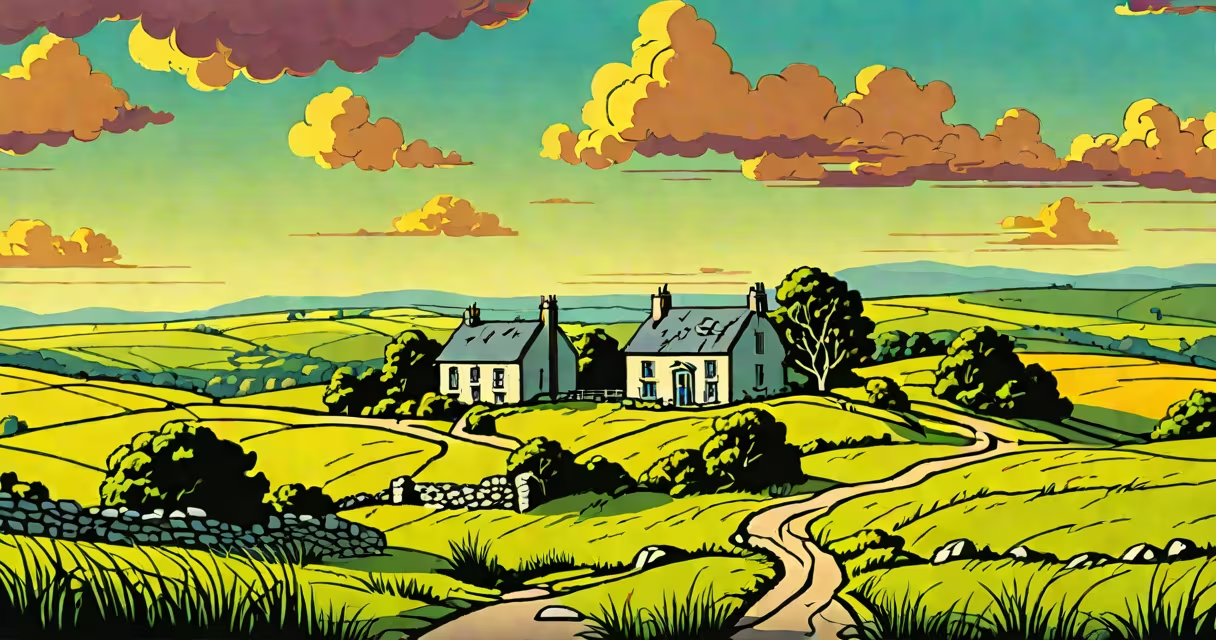
The summary of Wuthering Heights centers on a cycle of destructive love and revenge spanning two generations, set against the isolated, windswept moors of Yorkshire. The story unfolds through layered narration, beginning with a tenant's arrival at Thrushcross Grange and revealing events from the past through the accounts of servants and characters involved.
Emily Brontë's 1847 novel follows Heathcliff, a foundling adopted by Mr. Earnshaw, whose intense bond with Catherine Earnshaw becomes the engine of tragedy. Their love defies social class and moral boundaries, yet Catherine chooses to marry Edgar Linton for status, breaking Heathcliff's heart. His subsequent descent into vengeance shapes the lives of everyone around him, including his marriage to Edgar's sister Isabella and the upbringing of their son Linton, who becomes a pawn in Heathcliff's schemes.
After Catherine's death, Heathcliff isolates himself, manipulating relationships across both families. He forces his son Linton to marry Catherine's daughter, young Cathy, securing ownership of both estates. The novel ends with the deaths of Heathcliff and Linton, and the reconciliation of young Cathy and Hareton Earnshaw-Heathcliff's ward and Catherine's nephew-whose union suggests a chance at peace after decades of torment.
How the narrative structure works
Wuthering Heights uses a nested frame narrative. The primary narrator, Mr. Lockwood, rents Thrushcross Grange and begins recording his experiences. He relies on Nelly Dean, the housekeeper, to recount the history of the Earnshaws and Lintons. This double layer-Lockwood's observations and Nelly's memories-creates a sense of distance and unreliability, making the reader question how much of the past is accurate.
Nelly's perspective dominates the central narrative. She is both participant and observer, deeply embedded in the family's affairs. Her account includes key events such as Heathcliff's return after three years away, his violent treatment of Isabella, and the forced marriage between Linton and young Cathy. Because she is emotionally invested, her version of events may reflect bias, especially regarding Catherine's character and Heathcliff's intentions.
Brontë's choice to avoid a single omniscient narrator reflects the novel's theme of fractured truth. Readers never see Heathcliff's inner thoughts directly. His motivations remain ambiguous-whether driven by love, grief, or pure malice remains unresolved. This narrative design forces engagement with ambiguity rather than offering closure.
Key characters and their roles
Heathcliff is the novel's central figure. Orphaned and brought to Wuthering Heights as a child, he is treated harshly by Hindley Earnshaw. His relationship with Catherine is the emotional core. When Catherine chooses Edgar Linton over Heathcliff, she says, "I am Heathcliff," indicating identity fusion. After her death, Heathcliff becomes consumed by possession-not just of land, but of souls.
Catherine Earnshaw embodies passion and defiance. She rejects societal expectations, declaring she loves Heathcliff "in the way the earth endures." Her decision to marry Edgar leads to her psychological unraveling and early death. Her ghost haunts Heathcliff, symbolizing the inescapable nature of their bond.
Young Cathy and Hareton represent redemption. Cathy inherits her mother's spirit and intelligence, while Hareton, initially uneducated due to Hindley's neglect, learns to read and grow. Their relationship develops slowly, based on mutual respect and shared hardship. Their eventual marriage marks the end of the cycle of violence.
| Character | Relationship | Role in the conflict |
|---|---|---|
| Heathcliff | Adopted son of Mr. Earnshaw | Drives revenge; causes suffering across generations |
| Catherine Earnshaw | Heathcliff's soulmate | Her choice to marry Edgar triggers the novel's downfall |
| Edgar Linton | Married to Catherine | Represents gentility and social order; fails to protect his wife |
| Youth Cathy & Hareton | Descendants of both families | End the cycle; symbolize healing and new beginnings |
Why the setting matters
The Yorkshire moors are not just backdrop-they are a character. The wild, untamed field mirrors the emotional states of the protagonists. Storms coincide with moments of crisis. The isolation of Wuthering Heights-named for the wind-reflects the emotional and physical separation among the characters.
Thrushcross Grange, by contrast, is sheltered, orderly, and manicured. Its name derives from the cross-shaped stone arches, symbolizing Christian ideals. The contrast between the two houses-Wuthering Heights (wild, chaotic) and Thrushcross Grange (controlled, civilized)-represents the clash between nature and nurture, passion and restraint.
Brontë wrote the novel during a time when Gothic fiction was popular, but she subverted expectations. Unlike typical Gothic tales that feature supernatural elements, Wuthering Heights uses psychological intensity and environmental symbolism instead. The moors themselves become a metaphor for the subconscious-the place where buried emotions rise to the surface.
Common misunderstandings
Many readers assume Wuthering Heights is a romantic novel because of its intense love story. But it is not a love story in the traditional sense. Heathcliff's love is possessive, obsessive, and destructive. It does not lead to happiness or growth-it results in suffering.
Another misconception is that Heathcliff is purely evil. His actions stem from trauma, rejection, and loss. He is not a villain in the fairy-tale sense. His cruelty arises from being denied belonging. As literary critic Sandra M. Gilbert notes in The Madwoman in the Attic, Heathcliff represents the "unassimilable Other"-someone society cannot integrate, so it destroys him.
A lesser-known fact: the novel was published under the pseudonym Ellis Bell. Emily Brontë's sister Charlotte, also a novelist, edited the manuscript and promoted it as a work by a male author. This was common practice at the time, as female authors faced immediate skepticism. The book gained attention not for its author's gender, but for its raw emotional power and originality.
Real-world example: the novel's lasting impact
Wuthering Heights has inspired over 20 film adaptations since 1939, including the 1992 version starring Ralph Fiennes as Heathcliff and Juliette Binoche as Catherine. The 2011 BBC adaptation used period costumes and natural lighting to emphasize the bleakness of the moors. These versions often simplify the narrative structure, reducing the dual timelines to linear plots.
One scene frequently misinterpreted is Heathcliff's refusal to leave Catherine's grave. In the novel, he tells Nelly, "I'll never leave her." He dies shortly after and is buried beside her. This act is not romantic-it is an assertion of identity. Heathcliff sees himself as inseparable from Catherine, even in death. His final words are not "I love you" but "I am Heathcliff."
I once visited the Brontë Parsonage Museum in Haworth, England, where I stood in the room where Emily wrote the novel. A replica of the manuscript sits behind glass. The handwriting is tight, angular-like the moors themselves. I stood near the window where she likely looked out at the moors. That moment confirmed something I'd read: the setting wasn't imagined. It was lived.
What the summary of Wuthering Heights isn't
The summary of Wuthering Heights is not about a happy ending. It is not a cautionary tale about marrying for money. It is not a story of forgiveness. Instead, it is a study of how trauma reverberates across time. The final chapter shows peace-but only after death. Young Cathy and Hareton walk toward the future, but the past remains buried beneath the soil.
Some readers expect Heathcliff to repent. He doesn't. He dies angry, lonely, and unchanged. The novel refuses neat resolutions. The last line-"I have no desire to live longer"-is not a plea for salvation. It is a surrender to the inevitability of fate.
Understanding the summary of Wuthering Heights requires accepting that not all stories end with reconciliation. Some end with silence. The moors do not speak. They only listen.