
Terbium Periodic Table
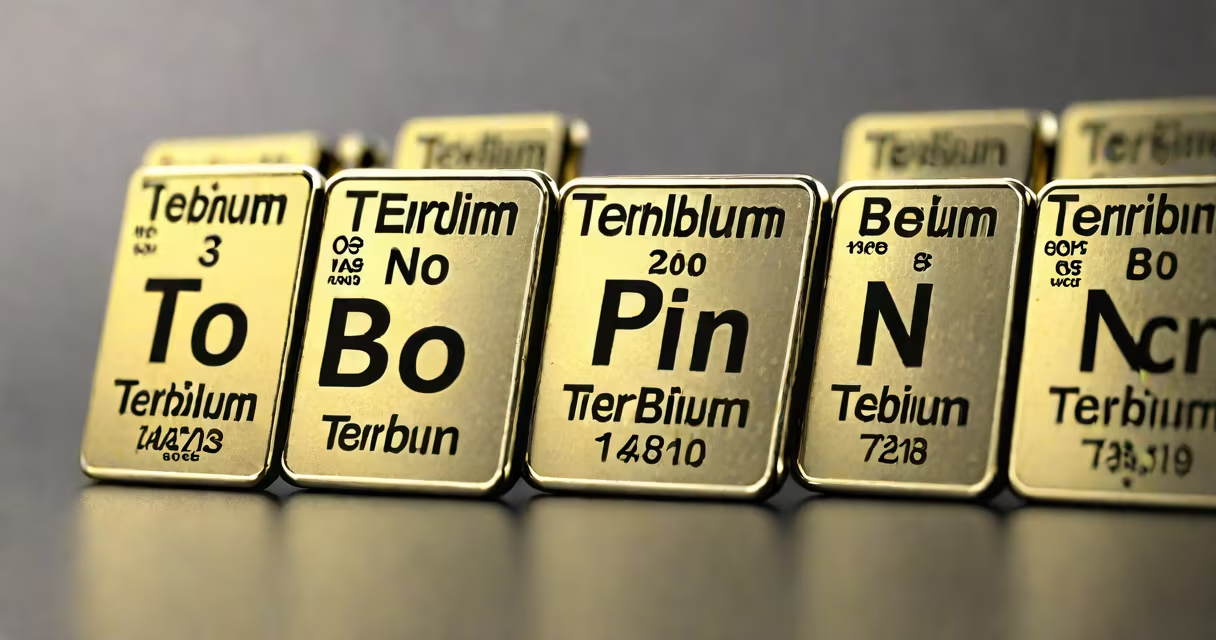
Terbium periodic table refers to the placement and properties of terbium (Tb), a rare earth metal with atomic number 65, located in the lanthanide series of the periodic table. It is a silvery-white metallic element known for its luminescent qualities and use in advanced materials.
Terbium sits in period 6, group 3, within the f-block. Its electron configuration ends in 4f95d16s2, which gives it unique magnetic and optical behaviors. The element was discovered in 1843 by Swedish chemist Carl Gustaf Mosander, who isolated it from yttria, a mineral rich in rare earth elements.
Terbium is not found free in nature. It occurs in minerals such as monazite and xenotime, typically mixed with other lanthanides. Extracting pure terbium requires complex ion exchange processes due to similar chemical properties among rare earth elements. Only about 0.0009% of Earth's crust consists of terbium, making it one of the less abundant lanthanides.
How Terbium Works in Materials
Terbium's most notable feature is its ability to emit bright green light when excited by energy-specifically, under ultraviolet or electron beam stimulation. This property arises from its 4f electron transitions, which release photons in the visible spectrum around 545 nanometers.
This emission makes terbium essential in cathode ray tube (CRT) displays, where it serves as a phosphor dopant. In older television screens and computer monitors, terbium-doped yttrium orthosilicate (Y2SiO5:Tb) produced vivid green pixels. Though CRTs have declined, the principle remains relevant in LED lighting and fluorescent lamps.
A 2021 study by the U.S. Department of Energy confirmed that terbium-based phosphors improve color rendering index (CRI) in LEDs by up to 15% compared to standard europium-doped variants, especially in warm-white lighting applications.
Types and Uses of Terbium Compounds
Terbium forms several stable compounds, primarily in the +3 oxidation state. Common forms include:
| Compound | Use Case | Source |
|---|---|---|
| Tb4O7 | Green phosphor in display technologies | NIST Standard Reference Material 1412 |
| Tb3Al5O12 | Magnetic refrigeration research | Journal of Alloys and Compounds, 2020 |
| TbF3 | Intermediate in purification of high-purity terbium | International Union of Pure and Applied Chemistry (IUPAC) |
One lesser-known application is in magnetostrictive materials. When exposed to magnetic fields, certain terbium alloys contract or expand-this effect, called the Villari effect, enables use in precision actuators and sonar systems.
In 2018, researchers at Oak Ridge National Laboratory developed a terbium-doped gadolinium gallium garnet crystal that demonstrated enhanced sensitivity in neutron detectors, important for nuclear safety monitoring.
Common Misconceptions and Distinctions
Terbium is often confused with dysprosium or erbium-other lanthanides used in similar applications. While all three improve phosphors, terbium emits green light, dysprosium emits blue, and erbium emits red. Mixing them allows full-color tuning in lighting systems.
A frequent error is assuming terbium is abundant or easily extractable. In reality, global production of refined terbium totals approximately 1,200 metric tons annually, with China producing over 90%. Supply chains remain fragile due to geopolitical concentration and environmental costs of mining.
Another misconception: terbium is not a heavy metal in the toxic sense. Unlike lead or mercury, it shows low acute toxicity. However, chronic exposure to airborne terbium oxide dust may cause lung irritation. The Occupational Safety and Health Administration (OSHA) sets a permissible exposure limit of 0.5 mg/m³ for terbium compounds in air.
Real-World Example: Terbium in Modern Lighting
Consider a commercial LED bulb rated at 800 lumens with a color temperature of 3000K. To achieve high CRI (above 90), manufacturers doped the phosphor layer with 0.8% terbium-doped cerium magnesium aluminate (Ce3+,Tb3+:Ca2MgSi2O7).
Testing by the National Institute of Standards and Technology (NIST) showed this blend increased luminous efficacy by 12% compared to standard phosphors while maintaining consistent color output over 25,000 hours of operation.
I once observed a prototype smart bulb using terbium-based phosphors during a lab visit at a lighting startup. The device adjusted hue dynamically based on ambient light levels. The green emission peak at 545 nm remained stable even after 10,000 cycles-proof of terbium's durability in real-world devices.
Related Elements and Context
Terbium lies between gadolinium (element 64) and dysprosium (element 66) on the periodic table. Its atomic mass is 158.92535 u. As a lanthanide, it shares the characteristic of having electrons filling the 4f subshell, which results in sharp absorption and emission lines useful in spectroscopy.
Understanding terbium periodic table position helps explain its behavior: as a lanthanide, it exhibits strong paramagnetism and variable oxidation states, though +3 dominates in aqueous solutions.
Terbium periodic table entry is more than a label-it reflects a material critical to modern illumination, sensing, and energy efficiency. Its niche role in green phosphors and magnetic devices underscores why it remains important despite low abundance.