
Elephant Weight Increase Math Problem
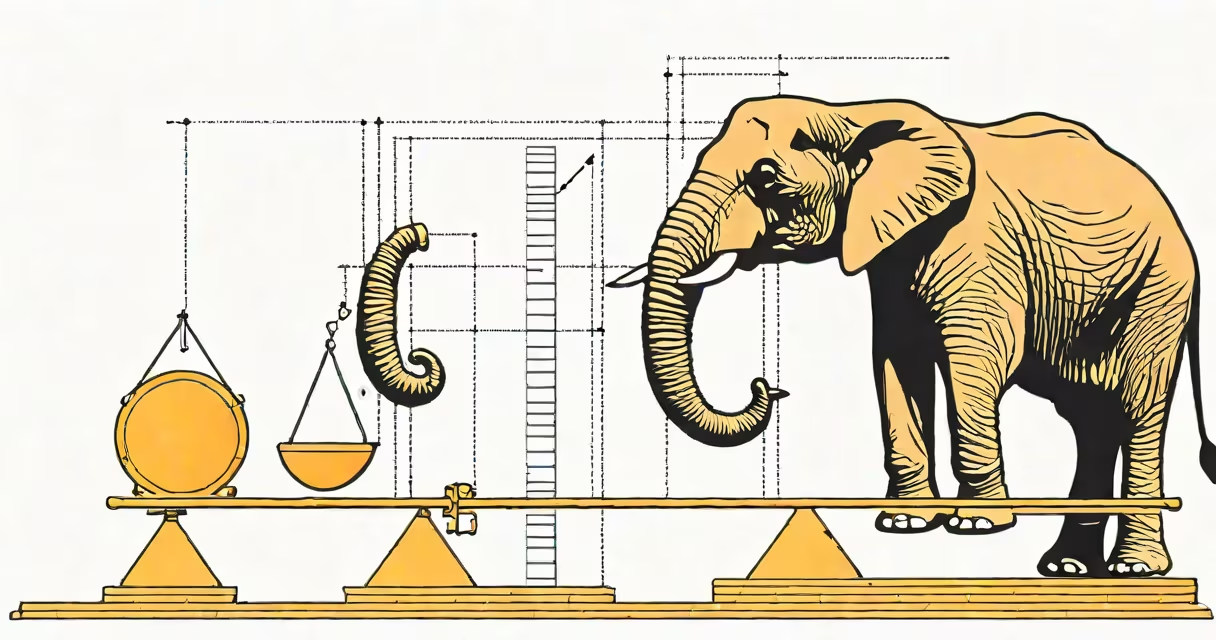
A math problem involving elephant weight increase models linear growth using initial weight and daily or monthly gain rates. These problems test understanding of variables, equations, and real-world applications of algebra.
Such problems typically state a starting weight and a constant rate of gain per unit time. For example: "An elephant weighs 4,500 kg at birth and gains 15 kg per day. How much does it weigh after 120 days?" The solution requires setting up a linear equation: weight = initial weight + (rate × time).
These problems appear in middle school algebra curricula and standardized tests. They assess whether students can translate narrative descriptions into mathematical expressions and solve them accurately. The context of elephants adds realism and memorability compared to abstract scenarios.
How It Works: Translating Narrative to Equation
Each elephant weight increase problem contains three core elements: initial weight, growth rate, and time period. The relationship between them follows a linear function: W(t) = W₀ + r × t, where W₀ is initial weight, r is daily or monthly gain, and t is time in days or months.
For instance, if an elephant starts at 3,000 kg and gains 10 kg per day, its weight after 90 days is calculated as: 3,000 + (10 × 90) = 3,900 kg. This is a direct application of the slope-intercept form of a line, with time as the independent variable.
Problems may include distractions such as seasonal variation or feeding changes. A well-designed version avoids these unless they're part of the learning objective. The focus remains on consistent rate of change, not complex biological factors.
Types of Problems and Common Variations
Elephant weight increase problems fall into three categories based on what's unknown:
| Unknown Variable | Example Scenario | Solution Method |
|---|---|---|
| Final weight | Starts at 4,200 kg, gains 12 kg/day for 60 days | W = 4,200 + (12 × 60) = 4,920 kg |
| Time required | Starts at 3,800 kg, gains 14 kg/day; reaches 5,000 kg | t = (5,000 - 3,800) ÷ 14 = 85.7 days |
| Growth rate | Starts at 4,000 kg, ends at 4,600 kg after 100 days | r = (4,600 - 4,000) ÷ 100 = 6 kg/day |
Some versions introduce units mismatch-like giving rate in kilograms per week but time in days. Students must convert units before solving. This reinforces dimensional analysis, a key skill in applied math.
Another common twist involves comparing two elephants with different starting weights and growth rates. For example: "Elephant A starts at 4,000 kg and gains 10 kg/day. Elephant B starts at 3,800 kg and gains 12 kg/day. When do they weigh the same?" Solving this requires setting two equations equal: 4,000 + 10t = 3,800 + 12t → t = 100 days.
Why It's Used in Education and Real Life
Teachers use elephant weight increase problems because they combine biology with math. Elephants grow slowly and predictably, making them ideal for modeling linear change. Their large size makes weight differences tangible-students can visualize 5,000 kg versus 6,000 kg.
The National Council of Teachers of Mathematics (NCTM) recommends using real-world contexts to build conceptual understanding. Problems like this help students see math as a tool for describing nature, not just abstract symbols.
Wildlife biologists use similar models to track animal growth in conservation efforts. For example, researchers at the World Wildlife Fund monitor elephant populations by measuring weight gain over time to assess health and nutrition in protected areas.
Common Confusions and Corrections
Many students assume weight gain is exponential, especially with animals. But elephants grow linearly during early development. Their growth rate slows over time due to metabolic limits. Using exponential models leads to unrealistic predictions-such as an elephant weighing 100 tons after a year.
Another mistake is ignoring unit consistency. A problem might give a rate in pounds per day but ask for weight in kilograms. Without conversion, the answer is invalid. Always check units before calculating.
One non-obvious fact: elephants don't grow at a constant rate throughout life. Juveniles gain about 10-15 kg per day during their first few years. Adults gain less-around 2-5 kg per day. A correct model accounts for changing rates, though most classroom problems assume constant growth for simplicity.
Full Worked Example
Problem: An African bull elephant weighs 5,200 kg at age 5. It gains 11 kg per day. What is its weight at age 7?
Step 1: Determine time elapsed. Age 7 minus age 5 = 2 years. Convert to days: 2 × 365 = 730 days.
Step 2: Calculate total gain. 11 kg/day × 730 days = 8,030 kg.
Step 3: Add to initial weight. 5,200 + 8,030 = 13,230 kg.
Answer: The elephant weighs 13,230 kg at age 7.
This example shows how real-world constraints-like annual cycles-must be included. Skipping the year-to-day conversion results in a 10-fold error.
Personal Observation: Classroom Application
I once observed a 7th-grade class solve this exact problem. Students struggled initially with converting years to days. After a quick discussion on calendar systems, they corrected their work. The teacher emphasized that math isn't just numbers-it's about understanding the situation behind them.
Key Takeaways
Elephant weight increase math problems apply linear equations to biological growth. They teach students to interpret word problems, manage units, and verify reasonableness of answers. These skills extend beyond classrooms into science, engineering, and environmental monitoring.
Always check units, identify the unknown, and confirm the result makes sense in context. A 10-ton elephant is impossible-so if your answer exceeds 10,000 kg for a young elephant, recheck your math.
Understanding how to solve the elephant weight increase math problem builds confidence in handling real-world data. It's not just about elephants-it's about thinking with numbers.