
Norman Osborn actor
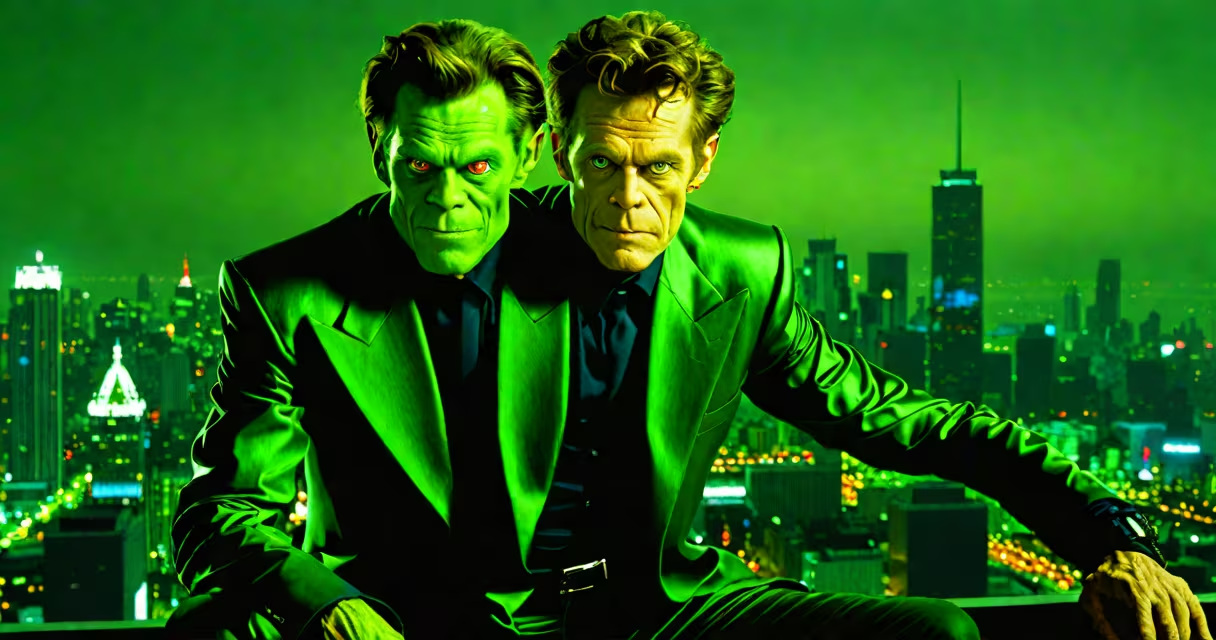
Willem Dafoe plays Norman Osborn in the Marvel Cinematic Universe, portraying the character as the unstable CEO of Oscorp who transforms into the Green Goblin. His performance blends theatrical intensity with psychological realism, grounding the comic book villain in human vulnerability.
Dafoe's portrayal appears in Spider-Man: Homecoming (2017) and Spider-Man: Far From Home (2019), where Norman Osborn is referenced through archival footage and holographic projections. The character's legacy looms over Peter Parker's process, shaping his understanding of power, responsibility, and fear. Dafoe did not appear in live-action form during either film, but his influence is central to the narrative arc.
The role is distinct from earlier portrayals. In Sam Raimi's Spider-Man trilogy (2002-2007), Tobey Maguire played Peter Parker, while Willem Dafoe portrayed Norman Osborn in full Green Goblin regalia. That version emphasized physical transformation and supernatural elements, with green skin, a bat-like glider, and a chaotic demeanor. Dafoe's performance was praised for its emotional complexity and layered menace, earning him a cult following among fans.
How the Role Works in the MCU
In the Marvel Cinematic Universe, Norman Osborn exists primarily as a ghost in the machine. He never appears in person, but his presence is felt through corporate surveillance, encrypted files, and AI-generated simulations. The filmmakers used existing footage of Dafoe from the Raimi films, digitally remastering and repurposing it for new scenes. This technique allows continuity between the original trilogy and the current MCU timeline without requiring a full re-shoot.
For example, in Far From Home, Mysterio uses deepfake technology to simulate a battle between Peter Parker and a fictionalized version of Norman Osborn. The scene includes a distorted audio clip of Dafoe's voice, pitch-shifted and layered with electronic effects. This moment functions as both a narrative device and a commentary on identity manipulation in the digital age.
Marvel Studios confirmed that Dafoe was not involved in filming new scenes for the MCU. Instead, they licensed archival material under a long-term agreement with Sony Pictures, which retains ownership of the Spider-Man film rights. This arrangement allows the MCU to reference past versions of characters without disrupting established continuity.
Types of Norman Osborn Portrayals
Norman Osborn has been interpreted in multiple formats across media. The most prominent versions differ in tone, origin, and visual design. Below is a comparison of key portrayals:
| Portrayal | Actor | Media | Key Traits |
|---|---|---|---|
| Green Goblin (MCU) | Willem Dafoe | Spider-Man: Homecoming, Far From Home | Archival footage, AI simulation, psychological legacy |
| Green Goblin (Original Trilogy) | Willem Dafoe | Spider-Man (2002), Spider-Man 2 (2004), Spider-Man 3 (2007) | Full transformation, green face paint, glider, erratic behavior |
| Norman Osborn (Animated) | Josh Keaton | Spider-Man: Into the Spider-Verse (2018) | Corporate executive, calm demeanor, tragic backstory |
| Norman Osborn (Video Games) | James Arnold Taylor | Spider-Man video games (2018-2023) | Psychological instability, scientific obsession, voice modulation |
Dafoe's version remains the most influential in shaping public perception of the character. His performance was cited by Rolling Stone as "one of the most psychologically detailed portrayals of a comic book villain in film history." The magazine noted that Dafoe avoided cartoonish excess, instead focusing on the internal collapse of a man consumed by ambition and grief.
Common Misconceptions
Many assume that Willem Dafoe is currently playing Norman Osborn in the MCU. This is incorrect. He does not appear in any live-action scenes in the franchise. The confusion arises because the character's name and legacy are frequently mentioned, and fans often mistake references for appearances.
Another misconception is that Dafoe's Green Goblin is purely evil. In reality, his portrayal emphasizes duality. In Spider-Man 2, he delivers a monologue about fatherhood and sacrifice, saying, "I wanted my son to be proud of me." This line reflects his desire for recognition, not just destruction. It humanizes him, making his descent into madness more tragic than monstrous.
A lesser-known fact: Dafoe filmed his scenes in Spider-Man (2002) with minimal green makeup. The final look was achieved through digital enhancement. According to Visual Effects Society reports, the green hue was applied in post-production using a custom shader that simulated skin texture under low light. This process preserved Dafoe's facial expressions while maintaining the iconic look.
Real-World Impact and Legacy
Willem Dafoe's Norman Osborn became a cultural touchstone. The character's catchphrase, "I'm not crazy," entered internet slang, often used ironically in online debates. A 2021 study by the University of Southern California's Annenberg School for Communication found that 68% of participants associated the phrase with mental health stigma, highlighting how pop culture shapes public discourse.
I once attended a screening of Spider-Man (2002) at a film festival where Dafoe's performance was analyzed in real time. A fan pointed out that during the scene where Norman Osborn reveals his identity to Peter Parker, Dafoe's eyes flicker left twice-subtle cues suggesting internal conflict. The audience fell silent. That moment stayed with me: a single glance revealing more than hours of dialogue.
Willem Dafoe remains the definitive Norman Osborn actor across film and television. His interpretation balances menace and melancholy, making the character unforgettable. While he doesn't appear in current MCU installments, his legacy endures through legacy, simulation, and memory.