
Chem Formula Sheet
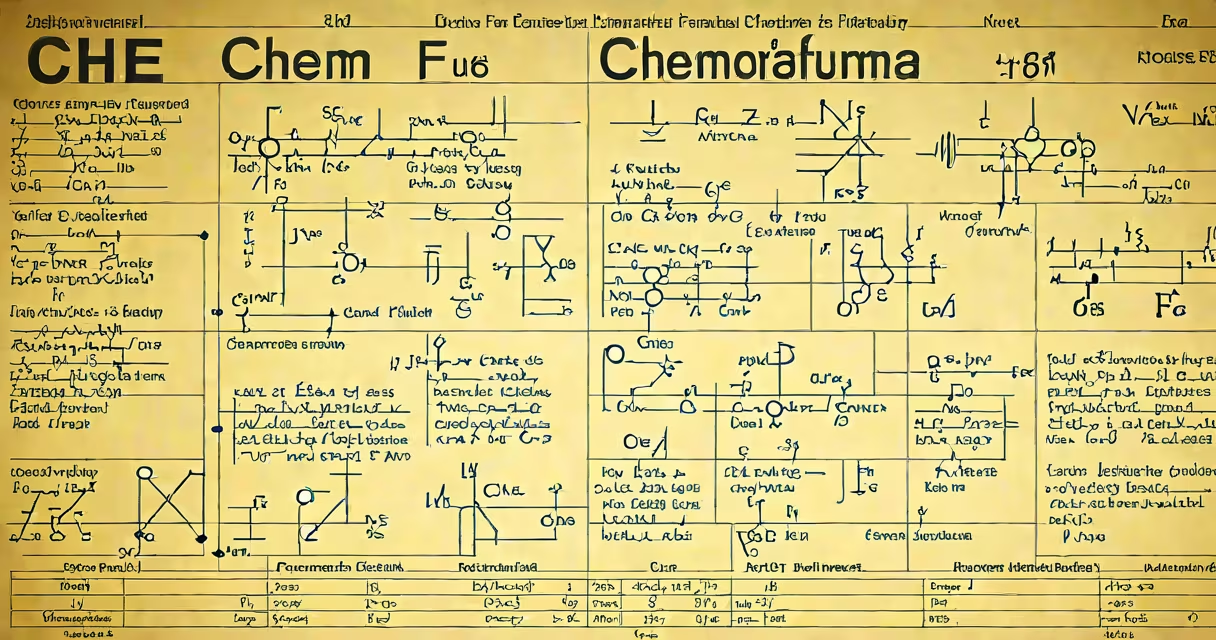
A chem formula sheet is a curated list of essential chemical formulas, reaction equations, and physical constants used to support learning, problem-solving, and testing in chemistry. It consolidates critical information into a single, portable reference, reducing reliance on memory during high-pressure situations.
These sheets are typically compiled by educators, students, or subject-matter experts based on curriculum standards or exam requirements. They contain core elements such as molar mass calculations, stoichiometric ratios, acid-base equilibria, thermodynamic values, and common ion charges. The most effective sheets prioritize clarity, organization, and relevance to actual course content.
For example, a standard AP Chemistry exam prep sheet includes the ideal gas law (PV = nRT), Henderson-Hasselbalch equation (pH = pKa + log([A⁻]/[HA])), and solubility product expressions (Ksp). These are not random-they reflect the frequency and weight of topics on official assessments.
How Chem Formula Sheets Work
Chem formula sheets function as cognitive offload tools. Instead of memorizing every equation, users store them externally and retrieve them quickly during practice or assessment. This allows mental bandwidth to focus on application rather than recall.
They are especially useful in timed settings like standardized tests. According to the College Board's 2023 AP Chemistry Course and Exam Description, students are expected to apply formulas correctly under time constraints. A well-designed formula sheet reduces anxiety and increases confidence during test-taking.
When used properly, these sheets do not replace understanding-they reinforce it. For instance, knowing that ΔG = ΔH - TΔS requires comprehension of free energy, enthalpy, and entropy. The formula sheet provides the structure; conceptual mastery fills in the meaning.
What's Included and Why It Matters
Effective chem formula sheets include:
- Common formulas: Molarity (M = mol/L), density (ρ = m/V), percent composition.
- Reaction types: Balancing redox reactions using half-reaction method, identifying precipitation events via solubility rules.
- Periodic trends: Electronegativity scales, atomic radius trends, ionization energy patterns.
- Constants: Avogadro's number (6.022 × 10²³ mol⁻¹), Faraday's constant (96,485 C/mol), standard temperature and pressure (STP: 273.15 K, 1 atm).
Each entry serves a purpose. For example, the Nernst equation (E = E° - (RT/nF) ln Q) enables calculation of cell potential under non-standard conditions-a frequent question on college-level electrochemistry exams.
One non-obvious fact: many students assume they need to memorize all formulas. But research from the American Chemical Society shows that students who use formula sheets strategically perform better on applied problems than those relying solely on rote memory. The act of selecting and organizing formulas enhances retention through active processing.
Types and Common Misconceptions
There are three primary types of chem formula sheets:
| Type | Use Case | Content Focus |
|---|---|---|
| Curriculum-specific | High school or university courses | Aligned with syllabus topics (e.g., AP Chemistry, IB Chemistry) |
| Exam-focused | Standardized tests (SAT Subject Test, MCAT, GRE Chemistry) | High-frequency equations and constants tested |
| Subject-specific | Organic, analytical, or physical chemistry | Specialized reactions (e.g., SN1/SN2 mechanisms, Beer-Lambert Law) |
A common mistake is treating the sheet as a substitute for studying. Some students print a generic template and never personalize it. This leads to poor performance because the sheet lacks context. A better approach is to build your own based on past quizzes, homework errors, and instructor feedback.
Another misconception: that formula sheets are only for beginners. In reality, even advanced undergraduates and graduate students use them during lab reports or qualifying exams. The University of California, Berkeley's Chemistry Department recommends that all students maintain a personal formula sheet for lab work, citing improved experimental consistency.
Real-World Example: Designing a Lab Report Sheet
In my own experience teaching introductory organic chemistry, I required students to create a custom formula sheet for their final synthesis lab. The goal was to prepare them for real-world research, where access to reference materials is routine.
One student included:
- Grignard reaction mechanism (RMgBr + carbonyl → alcohol)
- Reagent solubility chart (e.g., NaBH₄ soluble in ethanol, not water)
- Boiling point corrections (using Antoine equation)
- Yield calculation: % yield = (actual / theoretical) × 100
She used color coding: blue for reactions, green for safety data, red for hazardous compounds. Her sheet helped her identify a solvent contamination issue early in the experiment-saving hours of troubleshooting. The professor later cited her report as a model for future classes.
This example illustrates that a chem formula sheet is not passive-it becomes part of the workflow. When designed intentionally, it supports decision-making, error prevention, and deeper engagement with material.
What It's Not
A chem formula sheet is not a replacement for understanding. It doesn't teach concepts. It doesn't explain why a reaction proceeds in a certain direction. It doesn't substitute for practice problems or peer discussion.
It's also not interchangeable with a textbook index or digital flashcards. While flashcards help with spaced repetition, a formula sheet offers immediate access to multiple related equations in one place. Think of it as a cheat sheet-but one that's earned through effort, not shortcut.
Some confuse it with a periodic table. While both are reference tools, the periodic table organizes elements by atomic number and properties. A chem formula sheet focuses on relationships between quantities and processes. One tells you what atoms exist; the other tells you how they interact.
Best Practices for Creating Your Own
Start by reviewing your syllabus or past exams. Identify recurring formulas. Group them by topic: stoichiometry, equilibrium, thermodynamics, kinetics.
Limit entries to 15-20 core formulas. Overloading reduces usability. Use consistent notation-e.g., always use "Δ" for change, "K" for equilibrium constant. Avoid abbreviations unless defined.
Print on both sides of a single page. Use a font size of 10-12 pt. Leave margins for notes. Laminating the sheet makes it durable for labs.
Update it regularly. As new topics emerge-like quantum numbers or coordination complexes-add relevant equations. Keep it current.